Improving Prototyping Efficiency with Augmented Reality
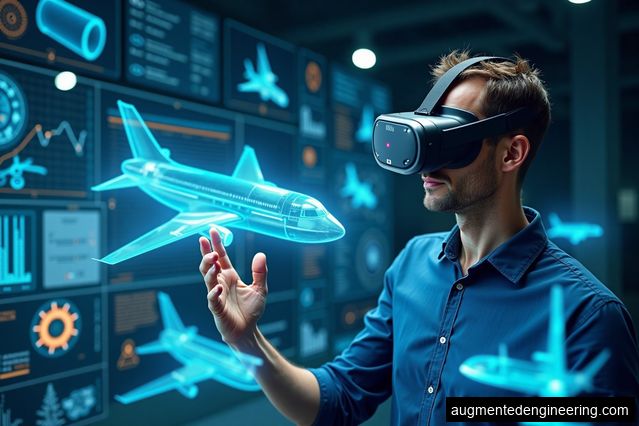
Aerospace engineering often involves complex designs and precise measurements. Traditionally, engineers relied on physical prototypes to validate their designs, which was a time-consuming and expensive process. However, with the integration of augmented reality (AR), aerospace engineers can now visualize and interact with virtual prototypes in real-world environments.
AR technology allows engineers to overlay virtual elements onto physical objects, providing them with a mixed reality experience. By using AR headsets or mobile devices, engineers can view and manipulate virtual prototypes, enabling them to identify design flaws, make modifications, and test various scenarios more efficiently. This streamlined prototyping process saves both time and resources, ultimately accelerating the development cycle.
Enhancing Collaboration and Communication
One of the primary advantages of AR integration in aerospace engineering is the improvement in collaboration and communication among team members. With AR, engineers can share virtual prototypes with colleagues in different locations, allowing for real-time collaboration and feedback. This eliminates the need for physical prototypes to be shipped or transported, saving significant costs and reducing the risk of damage during transit.
By visualizing the same virtual prototype simultaneously, engineers can discuss design changes, simulate assembly processes, and identify potential issues more effectively. AR also enables engineers to annotate virtual prototypes with notes, comments, and instructions, ensuring that all team members are on the same page. This enhanced communication leads to better-informed decision-making and ultimately improves the overall quality of the final product.
AR Applications in Aerospace Engineering
AR integration in aerospace engineering offers numerous applications across various stages of the product development lifecycle. During the design phase, engineers can use AR to visualize and evaluate their concepts in real-world environments, allowing for more accurate assessments and refinements. This helps reduce design iterations and ensures that the final product meets performance requirements.
In the manufacturing phase, AR can assist in assembly processes by overlaying step-by-step instructions and highlighting critical components. This improves the efficiency and accuracy of assembly operations, reducing errors and rework. Additionally, AR can be used for maintenance and repair tasks, providing technicians with real-time guidance and visualizations of complex systems, simplifying troubleshooting and minimizing downtime.
The Future of AR in Aerospace Engineering
As technology continues to advance, the potential of AR integration in aerospace engineering is limitless. The development of more advanced AR headsets with improved accuracy and a wider field of view will further enhance the user experience. Additionally, the integration of other technologies, such as artificial intelligence and machine learning, can enable AR systems to automatically detect and analyze design flaws, optimizing the prototyping process even further.
Furthermore, AR has the potential to revolutionize training programs for aerospace engineers and technicians. By providing immersive and interactive training simulations, AR can help individuals gain hands-on experience without the need for physical equipment. This not only reduces training costs but also ensures that professionals are well-prepared to handle complex aerospace systems.